


Wildlife conservation is essential for maintaining a healthy ecosystem and preserving biodiversity. It plays a crucial role in maintaining the balance of nature and ensures the survival of various species. Here are some of the key reasons why wildlife conservation is important- 1. Biodiversity, 2. Ecological balance, 3. Cultural importance etc. Overall, wildlife conservation is crucial for the survival and well-being of both humans and wildlife, and it is essential for maintaining a healthy and sustainable planet.
Under the project, wildlife conservation and collaborative management activities are being escalated in 32 protected areas. Besides, special afforestation activities are being implemented for the development of wildlife habitats and corridors. In the meantime, according to the DPP constitution, 2,940 hectares of gardens have been created. And nurseries encompassing 640 hectares of areas have been formed for the afforestation of the 2022-23 fiscal year. Moreover, some important steps have been taken to preserve the following 8 critical and endangered wildlife.
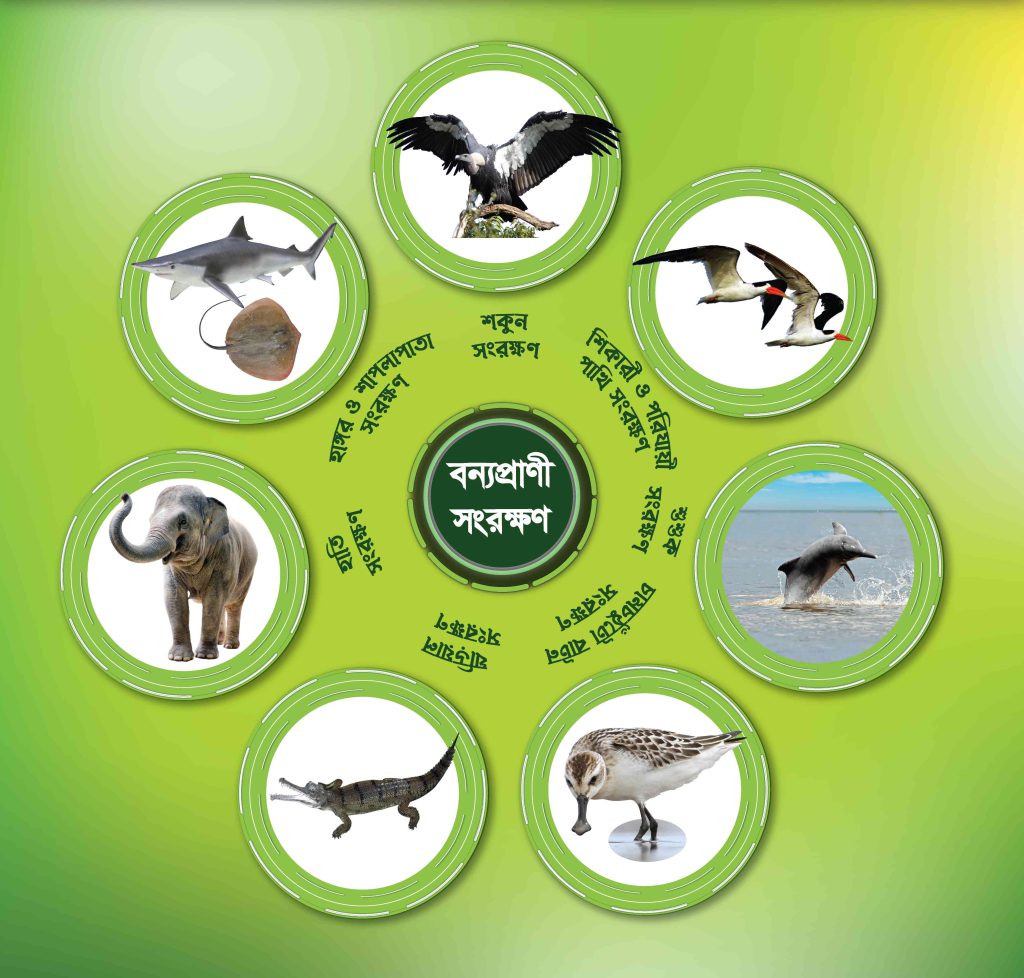
Avifauna Conservation
- A total of 10 surveys were performed to understand the current status of a total of 52 birds of prey, including 10 critically endangered birds of prey. Maps have been made about their spread and status.
- Through the camera trap, the breeding activities of native small eagles and mate-headed fish eagles were monitored and a proper list of their food during breeding period was given by looking at the pictures.
- At the field level, the birds of prey are assessed through interviews with the public and a complete list of the trees used to rest and nest them is given.
- A total of eight bird conservation teams were formed across the country to conserve birds of prey and training was provided in the conservation of birds of prey to increase efficiency.
- A Bengali guide called “Bird Conservation Guide” was created for the conservation of birds of prey and distributed to the members of the hunting bird conservation team.
- A total of 8 awareness meetings have been held in Singra, Rangpur, Sirajganj, Gaibandha, Tetulia, Bogra Sundarbans and Sunamganj to protect birds of prey.
- A video documentary has been made on birds of prey. The final documentary has been handed over to the forest department.
- The design work is going on by compiling the book “Raptors of Bangladesh”.
- A total of 03 Himalayan vultures have been tagged with satellite tags to know about their migration path. The tagged birds have migrated successfully. Their monitoring continues.
- A strategic plan “Conservation Strategic Plan for Raptors in Bangladesh” has been prepared for the conservation of birds of prey. It has been finalized after consultation with forest department officials.
- Regular surveys were conducted at six flyway sites of migratory birds.
- Migratory bird threats were assessed through interviews with local populations.
- A total of 6 site management committees have been formed to conserve migratory birds and training is provided in the conservation of migratory birds to increase efficiency.
- A Bangla guide titled “Bangladesh Migratory Bird and Migratory Area Conservation Guidelines” has been prepared to increase the efficiency of the members of the Site Management Committee in the conservation of migratory birds.
- Data were collected from 6 sites for site information sheet.
- Six awareness meetings have been held to conserve migratory birds.
- Seven migratory ducks and five more beach birds have been tagged with satellite tags to know about their migration routes. The tagged birds have migrated successfully. Their monitoring continues.
- A Bengali video documentary on migratory birds has been made.
- A strategic plan called “Strategic Conservation Plan for Flyway Sites of Bangladesh” has been prepared for the management of flyway sites and has been finalized in consultation with forest department officials.
- A total of 46 birds were censused at 32 sites.
- Six bird ringing camps have been set up and about 414 birds of different species have been released safely wearing rings.
- A total of 265 samples were collected and tested to know about the spread of the disease from migratory birds. Of these, 30 samples tested positive for influenza-A virus.
- A three-day workshop was organized by 10 forest department officials to develop skills on bird counting and ringing techniques. Officers are also being trained at the field level.
- Awareness programs have been organized to observe two migratory days to conserve birds.
- A Bengali video documentary on bird ringing and census has been made.
- A management plan called “Strategic Action Plan for Bangladesh Wetlands with a Focus on Water Birds” has been prepared and finalized in consultation with forest department officials.
Elephant Conservation
- As part of the elephant conservation program, human-elephant conflict resolution activities have been undertaken.
- So far 72 Elephant Response Team (ERT) have been formed in Chattagram, Cox’s Bazar and Mymensingh and provided with necessary equipment.
- 6 awareness meetings were held in Chattagram and Cox’s Bazar.
- Data on human-elephant conflict collected from 2016-2021.
- ERT members trained in human-elephant conflict resolution.
- Training manual published.
Shark & Ray Conservation
- Surveys have been conducted on Shark and Ray conservation. 95 officials have been trained for this work.
- Non-Detriment Finding (NDF) for 2 shark and 2 Ray species have been formulated.
- Poster and brochure for protected Sharks and Rays of Bangladesh has been prepared.
- Shark and Ray conservation strategies have been developed.
- Demonstrations and awareness programs have been organized at 6 locations to increase awareness among coastal fisheries.
Vulture Conservation
- 36 Vulture Conservation Team (VCT) meetings have been conducted and VCT assessment data collection and analysis are completed.
- The Vulture feeding station has been maintained and renovated. 28 cattle provided as food at Rema-Kalenga WS.
- A series of 6 advocacy meetings were held under the project.
- 3 pharma-group meetings were held including two short group meetings and a large national level meeting with leading pharmaceutical companies of Bangladesh and relevant stakeholders.
- Survey conducted during this project, the results showed that there is no Diclofenac in the market, and the availability of safe drug in the market is 41.82%.
- Estimated current population of white-ramped vulture is 225 to 268 in Bangladesh.
- 1000 poster circulated and a video documentary prepared to raise mass awareness.
- 6 awareness programs were held including two International Vulture Day awareness celebrations.
- A total of 60 Himalayan Griffons has been rescued, treated and rehabilitated and released into the wild from Vulture Rescue Centers.
- Organized 3 capacity building trainings for Forest Department officials and other stakeholders.
Dolphin Conservation
- Consulting services for Dolphin Conservation Program is ongoing by WCS since 10 January 2024.
- The Dolphin survey has been completed. A total of 8 Dolphin hotspot has been identified and accordingly awareness education program and Dolphin Response Team formation completed.
Spoonbilled Sandpiper (SbS) Conservation
- An agreement between BFD/SUFAL and EQMS consulting firm was signed on 1 January 2024 to implement conservation activities for the Spoon-billed Sandpiper.
- The population survey of the Spoon-billed Sandpiper in Sonadia Island, Nijhum Dwip, and the Meghna Estuary was completed last winter.
- The formation of the Spoon-billed Sandpiper Conservation Team (SCT) has been completed.
- Awareness materials have been developed, and awareness programs conducted.
Gharial Conservation
- Consulting services for Gharial Conservation Program is ongoing by IUCN since 15 February 2024.
- Field survey on captive Gharials in the country and one feasibility study of Gharials habitat and two Gharial population survey has been completed.
- Gharial Songrokkhon Sohayika for GCTs has been prepared. Field survey to identify a suitable location for the Gharials breeding center completed which identified a total of 6 Gharial hotspot.
- Two awareness programs conducted and 5 Gharial conservation team (GCT) formation is completed.
 Bengali